
In March 2026, the S.C. Department of Environmental Services (SCDES) and U.S. Environmental Protection Agency (USEPA) learned that Black Creek Elementary School, located at 2225 Leavensworth Road in Darlington, S.C., was recently built on land that had historically received biosolids, some from the nearby Galey & Lord facility, and these biosolids may have contained per- and polyfluoroalkyl substances (PFAS). School construction was completed in 2025, and the school first opened for the 2025-2026 school year.

SCDES worked closely with school district officials and USEPA as it conducted a thorough soil investigation. SCDES, in coordination with the school district, kept parents and guardians, faculty and the community notified about the soil investigation and the results.

After collecting and analyzing numerous soil samples from across the school property, the USEPA and SCDES have determined the amounts and types of PFAS compounds found in some soil samples did not present a risk to staff or students during the school year. In the long-term, there are no excess cancer risks or non-cancer risks for students or staff.

Please review this SCDES Black Creek Elementary School Fact Sheet and Statement from Darlington County School District, as well as the background information and full sampling results, all provided below. 

PFAS are a group of thousands of human-made chemicals that are sometimes referred to as "forever chemicals" because they don’t easily break down in the environment. PFAS have been widely used in consumer products and industrial applications since the 1950s because of their useful physical and chemical properties, especially stain, heat, oil, grease and water resistance. Some of these chemicals have since been linked to adverse health effects. Learn more about PFAS at epa.gov/PFAS, and learn about SCDES's ongoing efforts to assess the presence of these chemicals in South Carolina's natural environment at des.sc.gov/PFAS.

How are we exposed to PFAS?
Most people are exposed to PFAS from items they contact every day. PFAS are found at some level in most sources of drinking water and are used in a wide variety of consumer products. They are also present in some foods and packaging, fabrics treated with stain repellents, and even household dust.  

How do PFAS get into the environment?
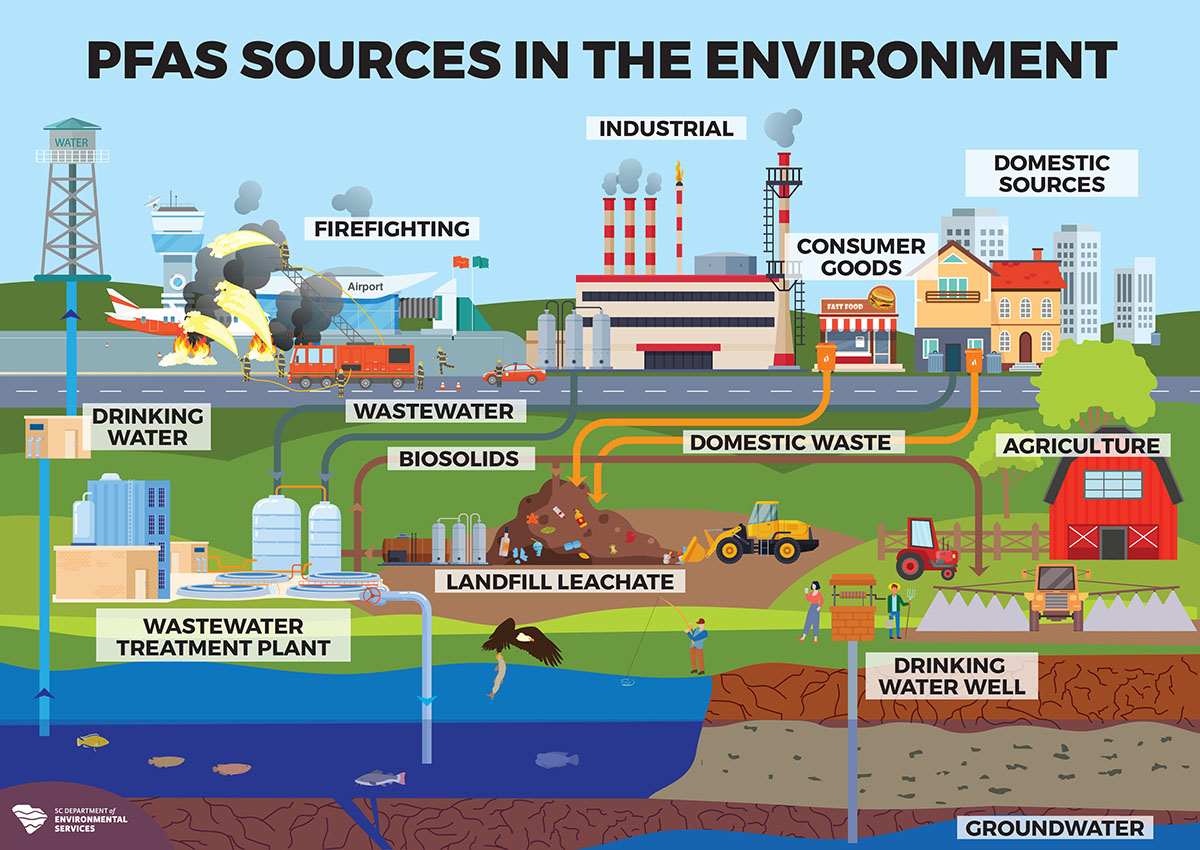
PFAS are human-made and are found worldwide. Higher concentrations are found in areas where the chemicals were manufactured, used in industrial applications or for firefighting, and in some commercial and consumer products. PFAS enter water supplies from industrial sources and wastewater discharges. Since PFAS don’t easily break down, they cycle throughout the environment. 

an image showing how industry and other activities contribute to PFAS accumulating into the environment


an image showing how industry and other activities contribute to PFAS accumulating into the environment

The Galey & Lord facility is a former textile mill and finishing facility located at 670 North Main Street in Society Hill, S.C. Facility operations began in 1966 which included dyeing, finishing, and surface treatment of cotton and synthetic fabrics. Additionally, during operations, sludge from the wastewater treatment tanks and basins onsite was routinely removed and applied on agricultural lands across a three-county area near the site.  

Operations continued until the facility was abandoned in 2016 without proper closure of the wastewater treatment facilities and associated unlined ponds and basins. As a result, there have been investigations into potential contamination of soil, groundwater, surface water and sediment at the Galey & Lord facility and surrounding areas.

Based on site investigations findings, the USEPA proposed listing the Galey & Lord facility to the Superfund program’s National Priorities List (NPL) in 2021. The listing was finalized in 2022, and the USEPA's investigation at this Superfund site is active and ongoing

Resources: 

Biosolids (also referred to as “sewage sludge") are a sludge that's a product of wastewater treatment operations that have been treated to meet USEPA requirements for use as a soil conditioner or fertilizer. Learn more from the EPA webpage Basic Information about Sewage Sludge and Biosolids.

In South Carolina, SCDES is responsible for issuing permits to entities that apply for permission to spread biosolids on land. State Regulation 61-9.503 Standards for the Use or Disposal of Sewage Sludge establishes the standards for biosolids/sewage sludge treatment and use in South Carolina.

Black Creek Elementary School is located at 2225 Leavensworth Road in Darlington. Construction of the school began in 2024, and the school first opened for the 2025-2026 school year. SCDES and USEPA learned in March 2026 that the school was built on land that was formerly a field that received land-applied biosolids from the Galey & Lord facility, which is now a federal Superfund site. 

Both agencies quickly began an investigation to determine whether there was any immediate risk that students, teachers or faculty could be exposed to PFAS in outdoor areas where biosolids/sludge was applied to the soil decades ago. SCDES and the USEPA contacted the school and school district's leadership to discuss sampling soil at the school.

SCDES collected 68 soil samples from the school property, with the majority of samples collected from the playground areas where students and staff spend most of their outdoor time and may be exposed to soil (see image). The soil samples were collected at depths from zero to six inches into the soil, and they were analyzed for metals, PCBs, pesticides, and PFAS. 

a map showing where soil samples were collected at the school


Results
Results (Soil Investigation Sampling at Black Creek Elementary School: Analytical Report) showed that metals, PCBs, and pesticides were not detected at levels of concern. 

Three PFAS compounds — Perfluorodecanoic Acid (PFDA), Perfluorooctanoic Acid (PFOA), and Perfluorooctanesulfonic Acid (PFOS) — were identified at levels above the USEPA’s Residential Regional Screening Levels. Residential Regional Screening Levels (RSLs) are not regulatory standards; they are risk‑based values that establish a threshold to determine the need for further evaluation of potential risks due to exposure to a contaminant. 

Concentrations below RSLs are considered low risk and don’t require further action. Levels above RSLs trigger a risk evaluation. 

Because PFDA, PFOA and PFOS were identified above the RSLs, USEPA and SCDES conducted individual risk assessments for further risk evaluation. These risk assessments utilized the EPA's Guidelines for Carcinogen Risk Assessment, which is the complex, science-based framework used nationwide to evaluate potential human cancer risks associated with exposure to environmental contaminants. 

Both agencies’ individual risk assessments evaluated cancer risks and non-cancer risks over both the short-term (200 days, which is the length of the school year plus summer school) and long-term (eight years for children [pre-K through 5th grade] and 30 years for adults). The risk calculations also considered age-specific factors such as body weight, which outside areas they frequently used and behavioral factors (such as the ways children and adults interact with soil). Find SCDES's full calculations in our Risk Assessment Calculations Data, Black Creek Elementary School. 
 
Both agencies' individual assessments concluded consistent results: the concentrations for contaminants were below levels that posed an immediate health risk, and they did not present an exposure concern during the school year. Additionally, in the long-term, there are no excess cancer risks or non-cancer risks for students or staff.
 
Not all of the soil samples with detections of contaminants were located in soil from the playground; some were found in soil samples collected farther out on undeveloped school property.
 
Resources:

SCDES has communicated with school officials about options for covering exposed soil in play areas — such as adding grass, mulch, or other suitable materials. While not required, covering soil would help further reduce any potential exposure. PFAS is used in many products, so care should be taken not to substitute one product for another without knowing the PFAS content. As an example, artificial turf can contain higher concentrations of PFAS than were found in the soil.

Where people come in contact with PFAS in soil, the exposure risk can be even further reduced by washing hands prior to eating or drinking and cleaning shoes to remove dirt after spending time outside.

It’s not reasonably possible to eliminate PFAS exposure altogether because these chemicals are present in food, water, and many different consumer products — such as carpet, upholstery, clothing, toiletries, cosmetics, food packaging and more — as well as throughout the environment. However, consumer PFAS exposure can be reduced by limiting the use of products that contain PFAS.