
Air Quality Forecast 

The South Carolina Department of Environmental Services (SCDES) provides daily forecasts for air pollutants across the state. These forecasts help South Carolinians take precautions on days with expected increases in Ozone and Particulate Matter. 

Ozone forecast season runs from April through September. Fine particulate Air Quality Alerts will be issued as needed.

Air Quality Index 

The Air Quality Index (AQI) is a national air standard rating system developed by the U.S. Environmental Protection Agency. The AQI is used statewide to provide the public, on a daily basis, with an analysis of air pollution levels and possible related health risks.

Daily AQI ColorLevels of ConcernValues of IndexDescription of Air Quality
GreenGood0 to 50Air quality is satisfactory, and air pollution poses little or no risk.
YellowModerate51 to 100Air quality is acceptable. However, there may be a risk for some people, particularly those who are unusually sensitive to air pollution. 
OrangeUnhealthy for Sensitive Groups101 to 150Members of sensitive groups may experience health effects. The general public is less likely to be affected. 
RedUnhealthy151 to 200Some members of the general public may experience health effects; members of sensitive groups may experience more serious health effects. 
PurpleVery Unhealthy201 to 300Health alert: The risk of health effects is increased for everyone. 
MaroonHazardous301 and higherHealth warning of emergency conditions: everyone is more likely to be affected. 
Pollutants Highlighted

Ground-level Ozone is a colorless, reactive gas that forms through atmospheric chemical reactions between nitrogen oxides (NOx) and volatile organic compounds (VOCs) in the presence of sunlight. NOx and VOCs are typically emitted from sources such as vehicles, industrial facilities, and electric utilities. Exposure to ozone can cause breathing problems for children, people with asthma or other respiratory conditions, and adults working or exercising outdoors.

High ozone concentrations generally occur on hot, sunny days in the spring and summer – check your daily Ozone Forecast between April 1st – September 30th. 

Particulate Matter (PM) consists of tiny solid particles and liquid droplets in the air from vehicle emissions, industrial facilities, wood burning, and dust. The smallest particles—PM2.5—pose the greatest health risk, as particles can penetrate deep into the lungs and enter the bloodstream, causing serious respiratory and cardiovascular problems.

The SC Forestry Commission (SCFC) provides user-friendly maps that identify active wildfires and prescribed burn activities throughout South Carolina.  

The Saharan Air Layer has unique properties of warmth, dry air, and strong winds that can have significant moderating impacts on tropical cyclone formation and intensification.

SC Ambient Air Monitoring Network  

SCDES operates air monitoring stations across South Carolina to measure pollutants in outdoor air that harm public health and the environment. SCDES's South Carolina Ambient Air Monitoring Map provides locations of all the air quality monitoring stations in South Carolina.

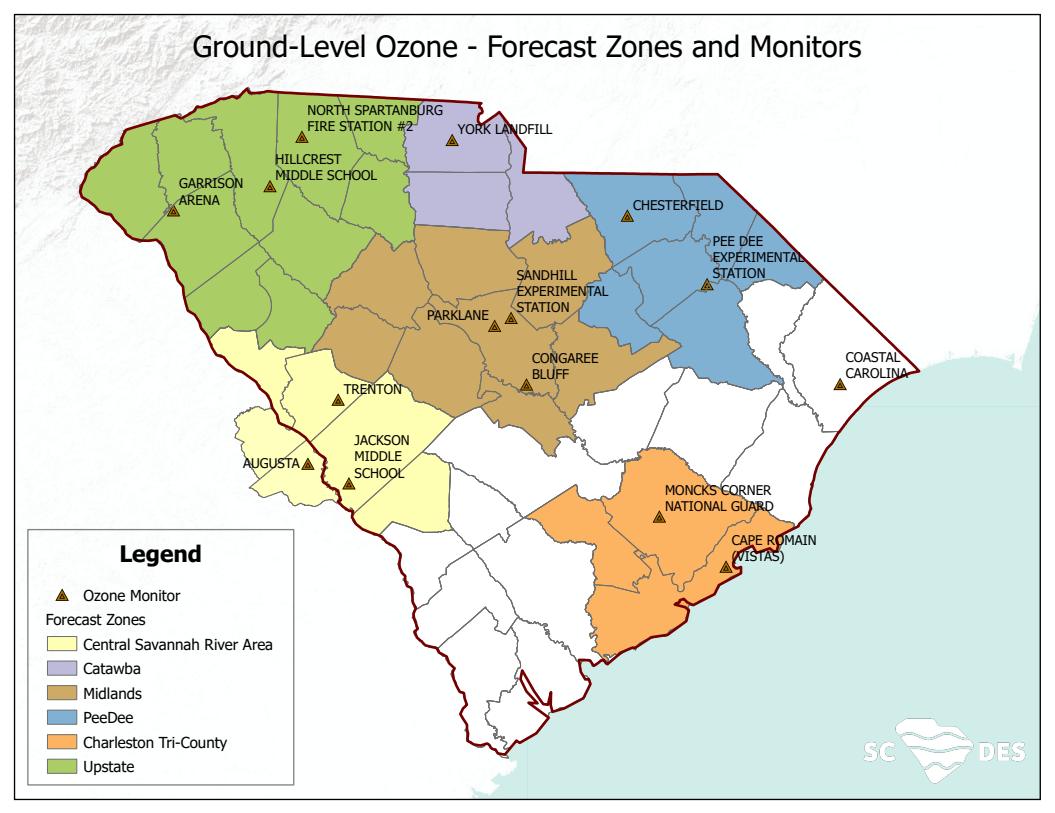
South Carolina Ozone Forecast Zone Map and Ozone Monitor Locations


You can also check your daily local and state air quality through EnviroFlash or EPA's AirNow mobile app. 


Contact

SCDES Modeling Section 

Gregory Quina, Modeling Section Manager 

Andrew Kingston, Lead Meteorologist