
The construction of solar energy system projects, commonly referred to as Solar Farms, often requires the owners/operators of the project to submit applications to local, state, and federal agencies before construction begins.  From SCDES, these often include:


ProgramActivities CoveredTiming of Submission
NPDES Construction StormwaterThis permit is required when the project will disturb one acre or more of land anywhere in the state. Before Construction Begins
401 Water Quality CertificationThis certification is necessary when the project includes impacts to Waters of the United States that require a 404 permit from the U.S. Army Corps of Engineers.Before Construction Begins
Coastal Zone Consistency CertificationCertification that permits issued in South Carolina’s 8 coastal counties are consistent with the state’s Coastal Zone Management Plan, including impacts to wetlands, threatened/endangered species and archeological & historic resources.Before Construction Begins
Registration for Solar Energy System DecommissioningOperators of solar energy systems of greater than 13 acres are required to submit to the Department a decommissioning plan for review and approval that addresses end-of-life management of solar panels and batteries. Five Years Prior to Solar Energy System Retirement

Beyond these, the South Carolina’s Energy Security Act (Act 41) established standards for the design and development of Solar Energy Systems with a footprint of more than thirteen acres of land. These rules apply in only those counties without rural zoning or an ordinance for solar energy systems. If a county has one or the other, the provisions of Act 41’s county considerations for solar energy systems don’t apply. 
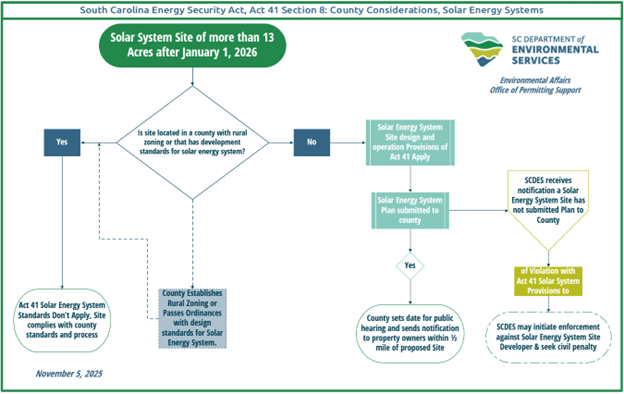
SCDES has SCDES recommends solar system operators contact the county in which they are seeking to construct a system to verify the status.

Counties Where Act 41 Solar System Provisions Apply
  • Allendale
  • Dillon
  • Laurens
  • Pickens

All other counties are exempt.

The following standards apply for Solar Energy Systems of more than 13 acres in Non-Exempt Counties:

  1. Site plans shall be prepared by a licensed land surveyor, landscape architect, or engineer in the State of South Carolina. Plans must be sealed.  
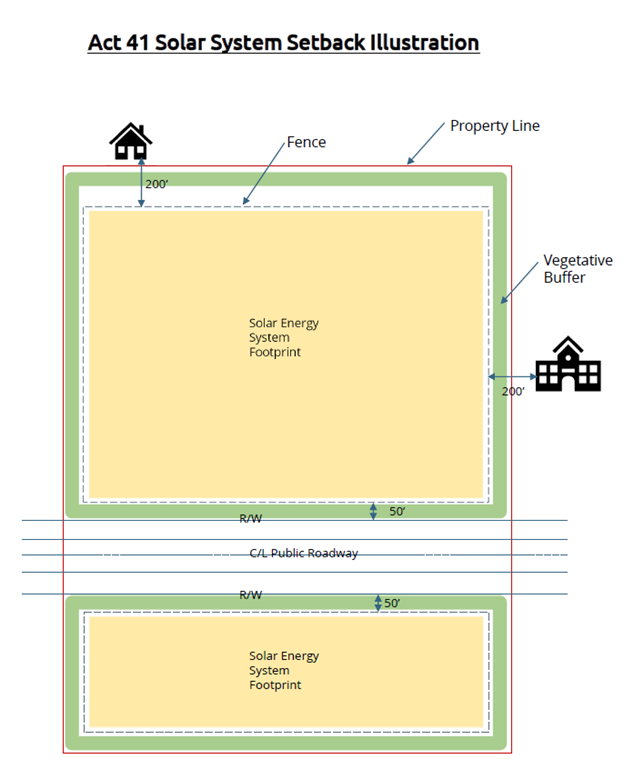
  2. Solar energy systems shall be set back fifty feet from adjoining property lines and road rights of way and two hundred feet from the nearest residence, church, or school. Setback distances are to the fence and are inclusive of the vegetation buffer.
  3. Solar structures shall not exceed fifteen feet in height. This provision shall not include the interconnection poles, substation equipment, or other devices necessary for the electricity to be delivered to the public utility station.
  4. Solar energy facilities shall be screened from adjacent public road rights of way, residences, churches, or schools with a vegetative buffer and fence or wall with the following specifications:  
    1. a vegetative buffer shall be installed adjacent to the solar energy system farm;
    2. the vegetation shall be planted in two staggered rows at a spacing interval between eight feet and ten feet on center and reach at least six feet in height over a three-year growing season and not less than fifteen feet in height at maturity or two feet higher than the highest panel, whichever is greater; and
    3. the vegetation shall include low lying vegetation to fill gaps between taller vegetation.  
  5. All lighting shall be shielded or directed in a downward position to prevent noxious glare. A light fixture is required at the ends of all turnarounds.
  6. Fencing shall be at least six feet in height to secure the perimeter. The fence shall be secure at all times.  
  7. A warning sign concerning voltage must be placed at the main gate to include the address and name of the solar energy system operator and a twenty-four-hour phone number for the solar energy system in case of an emergency.
  8. Solar collectors shall be designed with anti-reflective coating to minimize glare. Textured glass is optional. Mirrors are prohibited.  
  9. Submit and maintain an updated facility decommission plan consistent with the then current decommissioning requirements as required by the South Carolina Department of Environmental Services.  

S.C. Code Ann. § 6-26-1220(C), as amended through the South Carolina Energy Security Act, Acy, charges SCDES with the enforcement of the provisions of this section. Upon the failure of the owner or operator that is given notice of violation of this section to remedy the violation within thirty days, the Department of Environmental Services may impose civil penalties and require remediation for violations of the provisions of this section. Penalties may be not less than one hundred dollars nor more than five thousand dollars for each day of noncompliance. Penalties may be waived by the department for good cause for noncompliance shown by the owner or operator.

As we’ve noted, solar energy system construction typically requires permits from one or more SCDES regulatory programs, each maintaining records for the site.

To provide a mechanism to track the location and ownership of systems for Act 41, along with opening a platform for solar end-of-life registration at the onset of construction, solar energy system developers are encouraged to use the “Solar Registration” in ePermitting. You can find helpful instructions through the following link:  How to Register for SOLAR in ePermitting.

No. If a county has one or the other, the “County considerations, solar energy system” provisions of Act 41 aren’t applicable to the project. Owners or operators would be required to comply with the standards that county has established which may impact design and construction of a solar energy system. 

The Act doesn’t mandate the format or establish standards for what may constitute a county’s approval. Given the wide array of mechanisms utilized across the state by the counties, documentation should be in the form of a letter clearly stating that the solar energy project is in compliance with the county’s administrative review process. 

The six-foot fencing required to secure the perimeter of the Solar Energy Section should be placed adjacent to the panels with the vegetative buffer being situated within the property line.  The minimum setback distance of 200 feet to residences, schools, churches, along with the 50-foot setback to any public rights-of-way___0, is to span between the structure and the fence as illustrated here:  

solar system setback illustration

The Act doesn’t provide guidance on how to document compliance with the County Solar energy provisions. For solar energy system projects, subject to the provisions of S.C. Code Ann. § 6-29-1220 (A) (i.e. those without rural zoning or solar design standards), solar developers should submit documentation of compliance with the procedures outlined in S.C. Code Ann. § 6-29-1220(B), along with the county’s “approval”, to SCDES.

SCDES has elected to leverage the existing registration process instituted by our Bureau of Land & Waste Management for solar energy system decommissioning to track solar systems for Act 41.

South Carolina Resources for Solar Energy Systems