

Learn more about the SCDES Spare the Air Campaign
The Spare the Air Awards is the Bureau of Air Quality’s program that awards those who are working towards improving air quality in South Carolina. This award program recognizes environmental leaders, such as schools, organizations, businesses, and individuals that are working on projects and initiatives to protect air quality in South Carolina. Promoting a healthy environment through air quality initiatives that are sustainable and replicable,
Since 2008, SCDES has honored some of the top businesses, community groups, and individuals for implementing successful air quality initiatives in local communities throughout South Carolina. Past winners include:
2010 Winners
Dover Elementary School in North, SC implemented the Breathe Better (B2) program, which educates individuals about idling and its harmful effects on the human health and the environment. Thanks to their efforts, the Dover Green Team and the Clean Air Patroller were able to transform a positive change within their community.
Dover Elementary was able to achieve the following:
- Reduced idling from 72 percent to approximately 3 percent
- Adopted and implemented an anti-idling policy on campus; school bus drivers complied 100 percent
- Developed a plant policy to help replenish the oxygen level around the school
- Planted approximately 15 cedar trees
- Each classroom has adopted a tree and provides a monthly report
- Every year two new years are planted to honor the teacher and staff support person of the year
- Created a separate dismissal time for preschoolers, kindergarteners and their siblings to reduce idling
- Selected as the Greenest School in Orangeburg County
- Promoted long term impact on parents, staff, students and the community by reducing idling on and off campus and promoting anti-idling by displaying a vehicle decal
- Reduced fuel emissions for approximately 9,000 cars and 1,250 school buses
- Worked to expand the B2 program throughout the school district
The school was also recently featured in their local newspaper for their efforts at improving the environment.
Abibiti Bowater - Catawba Operations is committed to improving air quality for the benefit of the region. By doing so, this manufacturing facility has improved the quality of life for community residents, employees and is making a significant impact through sustainable initiatives.
Actions taken by Abitibi Bowater included:
- Planned and implemented several initiatives
- Carpooling
- Anti-idling
- Air quality alerts
- Increased participation among carpoolers, program currently has more than 90 participants
- Reduced facility's total energy usage and purchase energy use by 10 percent
- Installed permanent stickers on all light switches which encourages employees to turn off lights
- Lowered VOC emissions by conducting gas cap checks and replacing leaking caps
- Reduced NOX emissions by over 20,000 pounds per month by:
- Loading shed electric power during high demand periods
- Shut-off all non-essential office lighting every day
- Increased employee awareness by providing events and training
- Utilized and burned more biofuels and less fossil fuel
Abibiti Bowater - Catawba Operations was also featured in a recent local newspaper article for their efforts.
The Marine Corps Air Station Beaufort established an energy management system that significantly reduced energy usage throughout the base. It has conserved energy, saved money and provided approximately 700 families and employers with energy-efficient lighting and geothermal heat pump equipment.
The Marine Corps Air Station Beaufort successfully:
- Replaced inefficient equipment:
- Installed a cogeneration system to replace two fuel-fire boilers
- Installed a low plumbing in 100 buildings
- Installed seven energy chillers
- Increased the number of buildings with a geothermal heat pump system
- Achieved an energy savings of $188,000 during its 2010 construction period
- Saved approximately $1,000,000 in energy costs per year
- Served as a model for municipalities and large corporations
- Reduced air pollutant emissions (annual calculations):
- CO2:
- 24,979,091 pounds (energy management system)
- 14,760,236 pounds (geothermal)
- SO2:
- 200,047 pounds (energy management system)
- 65,796 pounds (geothermal)
- NOX:
- 65,794 pounds (energy management system)
- 10,996 pounds (geothermal)
- CO2:
The Marine Corps Air Station was also recently featured in their local newspaper for their efforts at improving the environment.
Pickens County is being honored for its initiative in developing a successful biodiesel conversion project. This project has saved the county money on fuel cost, improved the air quality as the result of using cleaner fuel, and promoted a healthier environment for its employees who drive and maintain these vehicles.
Pickens County was able to achieve the following:
- Established a biodiesel project
- Designed/installed equipment to produce biodiesel
- Collected biodiesel from several local restaurants and thirteen schools within the school district
- Retrofitted more than 16 vehicles to use this fuel
- Reduced an estimated 1,000,000 pounds of carbon emissions
- Developed a guidance manual for others to follow
- Served as a model for other counties and municipalities interested in developing a similar project
- Featured in the "Traveling Trash Bash" program (a local education program, sponsored by the Beautification and Advisory Committee in which third graders throughout Pickens County School District are encouraged to become environmental stewards)
- Provided presentations throughout the state regarding the program's effectiveness
Pickens County was also recently featured in their local newspaper for their efforts at improving the environment.
2011 Winners
Williams Middle implemented the Breathe Better (B2) program, which educates parents, students and teachers about and the potentially harmful effects of vehicle idling. The Environmental Educational Kiosk has kept parents informed about the school's anti-idling policy and encouraged them to modify their behaviors by turning their engines off while waiting in line to pick up students. It also serves as a vital tool in reaching a broader audience on various environmental issues that affect our state such as open burning, stormwater runoff.
Williams Middle was able to achieve the following success:
- Reduced the number of vehicles idling down to zero during after school pick up
- Reduced air pollution/exhaust emissions in the school zone
- Increased environmental awareness
The iRide program is an unique alternative rideshare initiative developed and implemented by the Santee Cooper Human Resource Department in September 2008. It has not only saved employees money on fuel and vehicle maintenance cost but has significantly impacted the lives of local residents and businesses by offering them options for their daily commute to work.
The actions of the iRide Committee included:
- Planned and implemented several initiatives:
- preferred parking for carpoolers
- payroll deduction of pre-tax dollars to purchase bus passes
- discounted bus passes
- provided free bus transportation during lunchtime to area restaurants for all employees
- Established express bus service options through a successful public/private partnership with Tri-County Link, the rural public transit provider for the area:
- services open to the general public
- available routes in Berkeley, Charleston and Dorchester counties
- access to wireless internet
- Increased employees' awareness by providing incentives:
- 583 employees participate in the program
- Utilized electronic software, AlterNet Rides, to track carbon emission reductions:
- saved 1,651,740 lbs. of carbon dioxide gas emissions
- successfully logged 4,849,371 miles
- reduced carbon footprint
Boeing South Carolina fabricates, assembles and installs systems in the construction of new airplanes. They perform thousands of processes each day, often utilizing many different chemicals that contain air pollutants known as Hazardous Air Pollutants (HAP) and Volatile Organic Compounds (VOC). In 2010, they began an aggressive campaign to reduce the amounts of these chemicals used at this facility. Through an extensive review of each process, Boeing discovered ways to make the most efficient changes.
As a result, Boeing updated their operating procedures, with the following results:
- Reduced air emissions
- lowered VOC emissions by 15 percent
- lowered HAP emissions by 65 percent
- Increased business performance
- enhanced inventory control practices
- improved hazardous materials management
- reduced waste disposal cost with smaller containers for chemicals
- Improved employee performance and productivity
- reduced time requirements for technicians to obtain materials
- reduced handling of bulk materials
- Served as a model for other businesses
The City and County of Greenville's Electric Vehicles Ecosystem Pilot Project is providing local companies and citizens with access to electric vehicles as well as a network of charging stations throughout the area.
The City of Greenville and Greenville County successfully:
- Saved cost and energy
- Increased consumer awareness
- Encouraged behavior changes
- Maximized job creation and economic benefits
- Served as a model for other municipalities and businesses
- Established a successful public/private partnership with Enterprise Rental Car, General Electric, Greenville Spartanburg International Airport and Thurso Power System:
- 10-15 electric vehicles available
- provided access to electric vehicles and charging stations
- doubled the number of charging stations to approximately 40
- convenient locations throughout the community
- Reduced harmful emissions
- reduced the number of gasoline powered vehicles on the road
- For every public car shared it is estimated that 14 private cars are taken off the road
- reduced carbon footprint (assuming driving 14,000 miles per year; 10-15 electric vehicles):
- 16,330 - 24,495 grams of NOx
- 21,000 - 31,500 grams of non-methane organic gas
- 979,900 - 1,469,985 grams of carbon monoxide
- 2,330 - 3,495 grams of PM reduction
- 4,200 - 6,300 grams of formaldehyde
- reduced the number of gasoline powered vehicles on the road
Sandra Yudice with Greenville County is being recognized for her outstanding contributions to improve air quality throughout her community. She has remained enthusiastic, dependable and committed to serving others.
Sandra has successfully:
- Coordinated and participated in community wide air quality events such as Lawnmower Exchanges, Car Care Clinics, school health fairs, festivals, and planting events,
- Developed and maintained a strong public/private partnership with schools, nonprofit organizations, and businesses in support of air quality improvement,
- Conducted presentations and lectures for public and private organizations, municipality planning committees and city councils to increase their awareness of issues related to air quality, and
- Participated as an expert panelist in sharing ideas and actions for improving local air quality at local and national conferences and workshops.
2012 Winners
Daniel Island Academy is a private preschool located in the City of Charleston which serves approximately 280 children. It is being recognized for its efforts in implementing an anti-idling campaign and educating staff, students and parents on the negative health and environmental impact of vehicle idling. The school takes pride in encouraging their teachers to attend training and educational workshops and sharing innovative ideas that engage and educate their children in the classroom on being good environmental stewards.
Daniel Island Academy has successfully:
- Adopted and promoted a no idling policy
- Posted no idling signage on campus
- Encouraged families to use alternative forms of transportation such as bicycles, golf carts and walking
- Increased awareness about anti-idling and its negative impact on the health of children and the environment
- Leadership and Energy in Environmental Design (LEED) members prepared and presented information on anti-idling initiative:
- Educated staff and identified expectations
- Prepared handout materials to be shared with staff and families
- Each classroom created a poster with important facts about vehicle idling
- Promoted Breathe Better (B2) campaign at its Fall Festival:
- Established an information booth
- Distributed educational materials and car decals
- Displayed student art projects and posters with creative slogans which included:
- "Ladies and Gentlemen, stop your engines!"
- "Kids breathe here!"
- "The key to breathing better starts with turning off your engines!"
For more than ten years, the Bosch Anderson Facility has implemented activities and processes to reduce their energy consumption. In 2011, the facility identified and completed four major projects that included replacing inefficient and outdated equipment. These changes resulted in a more improved, effective and productive facility.
Bosch Anderson successfully:
- Planned and implemented several energy efficiency initiatives
- Replaced an old compressor with a new air compressor
- Replaced the electric boiler system with an atomized water humidification system
- Upgraded HVAC system that now allows for:
- Zone control
- Night setbacks (automatically adjusts at night)
- Temperatures adjustments as weather conditions change
- Automatic shut-down in areas not in use
- Upgraded to a more efficient low-temperature co-fired ceramics (LTCC) desiccant air dryer
- Energy management control
- Decreased compressed air and electrical power usage
- Saved cumulatively 1.77 million dollars in energy cost
- Reduced CO2 emission by 1, 722 tons
- Achieved a 25% return on their investment
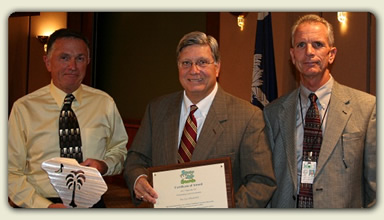
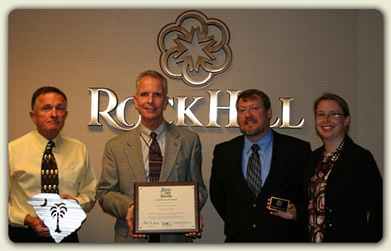
The City of Rock Hill is being honored for their efforts to improve air quality through alternative fuel usage. This initiative saved residents (county taxpayers) money on fuel cost, improved the air quality by reducing harmful emissions that injure the human health, the environment and cause property damage.
The City of Rock Hill successfully:
- Reduced fuel cost
- Increased public awareness
- Significantly reduced employees' exposure to harmful pollutants
- Proactive in implementing alternatives to gasoline powered engines
- Installation of thirteen electric vehicle charging stations throughout the city
- Installation of two time-fill and one fast-fill compressed natural gas fueling stations
- Open to the public
- Public-private partnership
- Routinely employed by Frito Lay fleet
- Commitment to sustainable and smart growth
- Featured in GMC commercial for its commitment to alternative fuels and commercial fleets
- Earned the inaugural 2010 Palmetto State Greenest Fleet Award presented by the Palmetto State Clean Fuels Coalition
2013 Winners
Midlands Biofuels earned recognition as Outstanding Business for its partnership with Lexington and Richland County School District Five and local restaurants in an initiative to collect used cooking oil and turn it into biofuel. This effort successfully increased environmental awareness among students, parents, faculty and staff, as well as local businesses in Lexington and Richland Counties, and reduced harmful emissions of pollutants such as air toxics, particulates and sulfur dioxide up to 80%.
The Upstate Air Quality Advisory Committee earned recognition for Outstanding Community Campaign for their actions and leadership in the Upstate to keep the skies in South Carolina clear and beautiful. This committee is comprised of business, community, and public service representatives from entities including BMW, Michelin, Duke Energy, Upstate SC Alliance, Upstate Forever, Ten at the Top, in addition to state and county governments. This diverse group of environmental leaders exemplifies community partnership at its best.
Through community projects, the committee reduced harmful emissions and successfully accomplished the following:
- Developed and implemented a Regional Air Quality Pledge, which encourages groups and individuals to adopt and implement actionable strategies designed to improve air quality.
- Promoted the Breathe Better Project, an idling/clean air campaign, on school campuses. Participating schools from the Upstate were qualified to receive funding from Ten at the Top grant initiative. As a result, schools participating in this region increased from 14 to 29.
- Expanded the anti-idling campaign beyond school grounds into the communities by posting signs in shopping centers and other parking facilities to remind drivers that idling is harmful to our health and the environment.
- Created a Clean Air Toolkit that includes a series of practical, easy to implement clean air tips. Messages were disseminated through promotional materials (fans and magnets), social media (Facebook) and electronic media (public service announcements).
The South Carolina State Ports Authority earned its recognition as Outstanding Local Government by developing and implementing emission reduction strategies that successfully led to positive behavior changes by truck drivers, port employees, shippers, and local/regional businesses.
These efforts have resulted in approximately a 50% reduction in total criteria pollution emissions since 2005 and successfully accomplished the following:
- Implemented a truck replacement and registration incentive, in which drivers were encouraged to upgrade and purchase a cleaner, more efficient trucks (approximately 84 trucks have been replaced).
- Established the SC Inland Port, which took approximately 100,000 trucks off the road and reduced supply chain emissions from 40% to 95%.
- Committed to and developed a clean construction policy on-site.
- Posted anti-idling signs at all facilities.
- Developed the shortest turn times on the east coast and the most efficient crane operations, which in turn reduced idling and fuel consumption.
- Developed a program to ensure that a minimal number of empty containers are transported around town which reduced the total number of truck trips and emissions.
- Partnered with EPA to develop a Ports Emissions Model Toolkit.
The residents of Charleston, Georgetown and Greer have directly benefited from the diminished truck traffic, reduced harmful emissions, increased awareness regarding more efficient truck fleets and improved air quality. These practices have also indirectly benefited residents and travelers throughout South Carolina, as well as all over the country.
2014 Winners
Rock Hill School District 3 has earned this honor for a number of efforts, including energy & water conservation; recycling & waste minimization; building construction efficiency; green cleaning; and sustainable practices in grounds keeping, land use, transportation and purchasing.
The district's Energy Management Program saves an estimated $2 million a year. It features outreach activities including a door decal and light switch design student art contest and a room shutdown contest. Over 80% of the district classrooms and offices are shutting down their energy systems completely. The district makes a free energy management tool, "GreenQuest," available to school families and staff, and also to organizations and businesses in Rock Hill. Real-time energy consumption data is used by students to study energy, science and social studies.
The district's recycling and waste minimization program leads the state in the percentage of solid waste recycled at over 36%. The recycling program incorporates competition within the district, and recycling data is used in the classroom.
The district's transportation initiatives include "no idling" policies for buses and service vehicles and idle reduction messages for car pick-up. Over 40% of the district's campuses participate in "walk to school day" or "bike to school day."
The University of South Carolina has earned this honor for a number of efforts, including reducing emissions in both vehicles and in stationary permitted energy sources through upgrading to more efficient equipment; "right-sizing" equipment to the job; improving bicycle, pedestrian and bus facilities and increasing bus service.
On December 1, 2009, USC unveiled its "Genesis 2015 Initiative" to move towards a petroleum-free fleet and reduce 90% of the carbon dioxide emissions from its fleet of 400 vehicles by the year 2015. This is being accomplished by powering USC's vehicles with ethanol, biodiesel, liquefied petroleum gas (LPG), electricity, or hydrogen fuel cells. As a result of this initiative, USC earned top green ratings from the Princeton Review and the College Sustainability Report Card in 2009.
In addition, the university's silver LEED certified residence hall, the "Green Quad," educates both students and the community at large about sustainability, and students can graduate with leadership distinction through participating in the Green Scholar program.
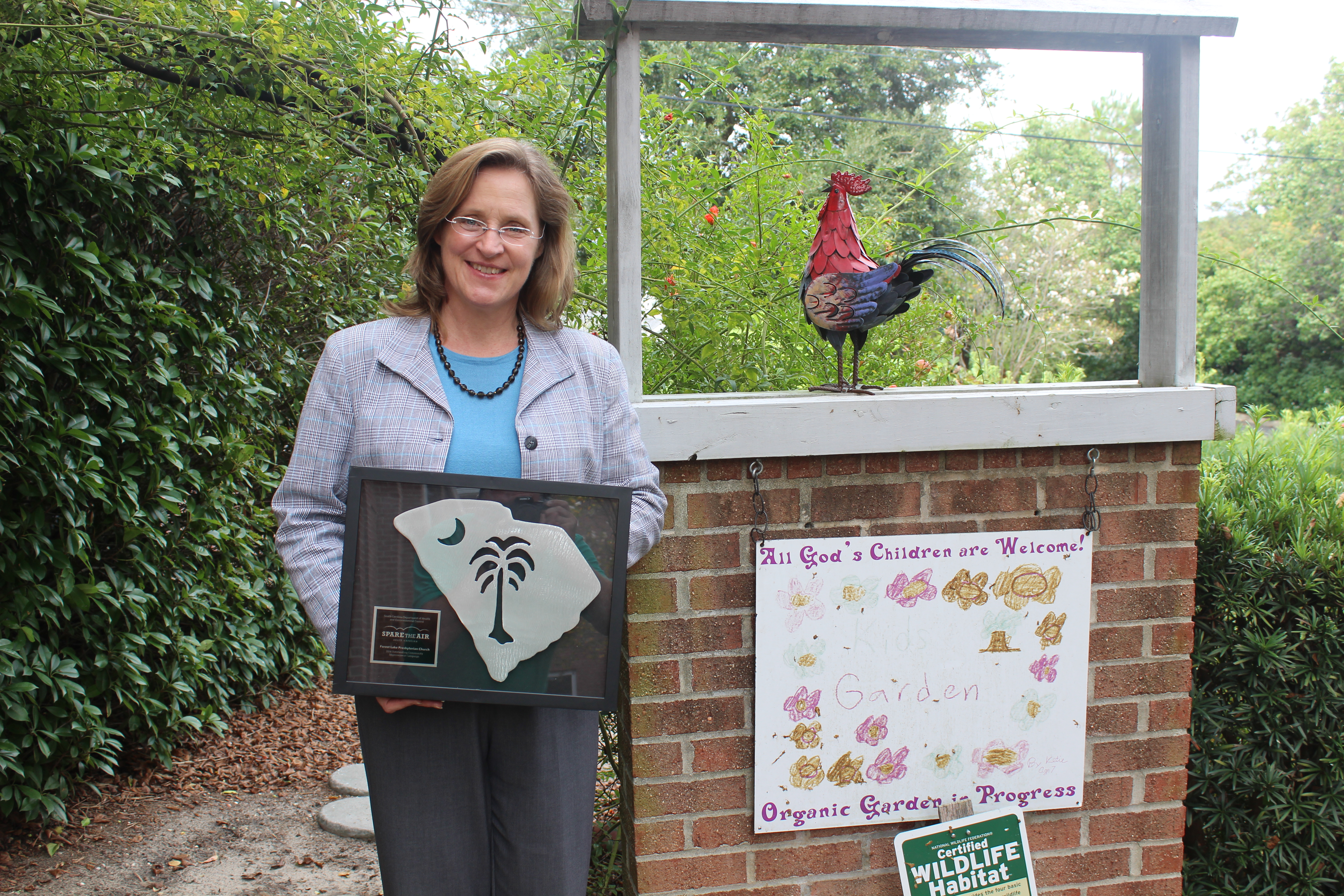
Forest Lake Presbyterian Church has earned this honor for establishing an organic garden and for collaborating with Harvest Hope Food Bank to distribute organic garden vegetables to those in need. This effort reduces emissions by providing food produced locally instead of having to transport food over long distances in trucks. Also, these efforts increase sustainability awareness through workshops for its congregation and community.
The City of Seneca/Clemson Area Transit has earned this honor for building a strong public/private partnership consisting of the City of Clemson, the Center for Transportation and the Environment, the South Carolina Department of Transportation, the United States Federal Transportation Administration and Proterra by successfully establishing the world's first all-electric municipal bus fleet. This fleet uses a system that burns zero fuel, creates zero pollution and minimal noise. These actions in turn reduce harmful emissions. CATbus and Seneca were featured in the Greenville News for their efforts and award.
2016 Winners
D. W. Daniel High School's Environmental Science Class was recognized by S.C. Department of Health and Environmental Control during Air Quality Awareness Week 2016 for its leadership and initiatives to protect the air and environment.
Students enrolled in D.W. Daniel High's advanced placement environmental science class led an event named "Inflation Station" in March 2015. The program aimed to increase student awareness of the environmental benefits of proper car maintenance and provide a service to the Pickens County community.
The goal of the Inflation Station was two-fold. One, students were made aware of the benefits of proper tire inflation and how mileage improvements directly help the environment. Specifically, increased miles per gallon reduce direct source car emissions because less fuel is consumed in daily commutes. Reductions in nitrogen oxides, greenhouse gases, respiratory irritants, ground level ozone precursors, and particulates were all realized with simple attention to tire pressure. In addition, drivers were taught how easy checking tire inflation truly can be.
In addition, students participated in data collection for the school's participation in the Breathe Better (B2) program. Students monitored idling cars and buses after school, and information highlighting the positive aspects of a no-idle policy was given to the vehicle drivers. "No idling zone" signs were also displayed to improve air quality as students waited for pickup.
Student-leaders took on all aspects of the project including: proposing and planning the project, meeting with Principal Josh Young to ask for permission, providing all the promotional information for the community, gathering all the inflation supplies (compressors, gauges, portable generators), organizing the traffic lanes and supplying the labor for tire inflation.
Prior to the event, students created announcements highlighting the importance of proper tire inflation and promoted the day and time of the event via website and daily announcements. Students were directed to the station on their way out of the parking lot where the environmental science students checked the tire pressure and then inflated the tires to the manufacturer's prescribed pressure as needed.
2017 Winners
The Clemson University Parking and Transportation Services department was recognized for its "Commute Choice Program," which demonstrates to students, faculty, and staff that driving a single occupancy vehicle is NOT the only way a person can commute to campus. The program promotes a carpool program, use of commuter and airport shuttles, use of the local all-electric municipal CATbus fleet, designated EV charging spaces, Zipcar car-sharing program, as well as a new BikeShare bike rental program.
The carpool program encourages the creation of carpool groups (two or more people per vehicle) in order to get free parking on campus. During the 2016 fall semester, 117 groups participated, which removed 154 cars driving to campus daily. The shuttles to and from satellite campuses transported 45,627 riders between Clemson and Greenville alone in 2016, and the free holiday shuttles between campus and the nearby airports consolidated 2,167 individual trips into just 185. Designated parking spaces with charging stations are available to staff with electric vehicles (EVs) on campus, and the university launched its first BikeShare program in April 2017. This diverse portfolio of commuting options improves regional air quality by encouraging commuters to get out of single occupancy vehicles and develop new, lower emission commuting practices.
The COMET of Central Midlands Transit was recognized for its Clean Fuels Fleet Expansion. The COMET began introducing propane-powered vehicles to its fleet in 2014, but in 2016 ramped up this effort. The COMET replaced 20 diesel "cutaway" shuttle-style vehicles with 21 propane vehicles and two standard mini-vans and ordered another eight small propane buses. Combined with its 2014 additions, this adds up to a total of 40 propane vehicles, which is the largest transit propane fleet in South Carolina and highest percentage propane fleet in the Southeastern U.S.
Propane vehicles can produce lower tailpipe emissions than diesel vehicles and as such do not require the same amount of emissions controls or maintenance as diesel vehicles. The COMET has worked with other transit systems across the State to share fleet performance as well as cost impacts. In 2017, the transit agency will take delivery of 31 clean-diesel buses to replace the same number of 2002-era diesel buses that have much lower exhaust emission standards and fuel economy. In addition to these great fleet upgrades, The COMET's ridership reached 2.5 million in 2016. This is up from 1 million riders in 2012 - 2013, is the highest ridership in over a decade, and continues to climb.
2018 Winners
River Bluff High School has participated in the "Breathe Better" Anti-Idling Campaign and Air Quality Flag Program for the past three years. Science teacher Amy Price leads the campaign for these two air quality programs at the school. River Bluff High School students check the Air Quality Index on the airnow website every morning to announce the air quality forecast. They raise a colored flag at the school to indicate the air quality for that day. One of the school's dedicated seniors, Caleb Thompson, makes sure the air quality flag is put up outside the front of the school each day.
The students also participate in Sonoco's Green Steps Environmental Program. For their air quality project for the Green Steps program, the students check the air for particulate matter and ozone levels both outside and inside the school building. To improve indoor air quality, the students use recycled cans as containers for "air quality purifying plants" and supply plants for every classroom.
The students continue to learn more about air quality by doing other ongoing projects, such as making plastic bag mats for the homeless and having a very active school recycling program. In addition, the school is in the process of building a greenhouse and buying two refillable water bottle stations.
In 2014, the Spartanburg County Foundation designated a Natural Environment Coalition within the Spartanburg Community Indicators Project. The Spartanburg County League of Women Voters participated in the Natural Environment Coalition and selected air quality as a focus. The Coalition's goal was to initiate an anti-idling campaign in all seven school districts in Spartanburg County, to help keep the air around schools healthy and inform school children and the public about the health benefits of not idling.
The campaign took hold under the leadership of volunteer Mary Ann Deku. She initiated a partnership with the "Breathe Better" Anti-Idling Campaign, sponsored by the South Carolina Department of Health and Environmental Control's Bureau of Air Quality.
Through Ms. Deku's efforts, sixteen Spartanburg County schools have been recruited to participate in the Breathe Better Anti-Idling Campaign, and two additional schools are participating in the Air Quality Flag Program. The schools that conducted an idling vehicle count as part of their anti-idling campaign produced a 40 percent reduction in idling among cars and a 54 percent reduction in idling among school buses. The Breathe Better Anti-Idling Campaign collaboration has also opened the door to other collaborations, including the installation of a vegetable garden at Carlisle Foster's Grove Elementary.
Tags
K12
Students
Teachers