

Updates on Lake Greenwood Fish Kill (April 13-20, 2026)

The S.C. Department of Environmental Services (SCDES) continues to investigate the cause(s) of an April fish kill that occurred in areas of Lake Greenwood in Greenwood County. State officials were notified of several dead fish in the Cross Hill area of Lake Greenwood after receiving reports from the public. No new reports of dead fish have been received since April 20.     

At this time, the cause(s) of the fish kill has not been determined. Current water quality data does not indicate a concern for consuming fish or recreating in the lake. SCDES reports no unusual water quality data based on commonly measured water quality parameters, and the S.C. Department of Natural Resources reports no indication of diseases or concerns among the fish sampled, to date.

This webpage will continue to be provided with updated information. Additional information can be provided to SCDES using our online ReportIt! tool (des.sc.gov/ReportIt) or contacting the agency at (803) 898-3432.

The investigation into the cause(s) of the fish kill that occurred between April 13-20 in areas of Lake Greenwood is ongoing. The S.C. Department of Environmental Services (SCDES) continues to perform sampling and assessments to try to identify the cause(s). 

At this time, the cause(s) of the fish kill has not been determined.  

Early in the investigation a general precaution was made to avoid contact with the water in areas where the fish kill had occurred, however, current water quality data do not indicate a concern for consuming fish or recreating in the lake. 

New key updates include:    

  • Additional site activities of nearby properties  
    SCDES provided maps, detailed summaries and findings of its site activities at nearby properties in the May 8 update. New information based on additional site investigations is available here, highlighted in yellow. Sampling data continue to indicate no impacts to Lake Greenwood from nearby properties.    

  • pH Data in Lake Greenwood 
    As provided earlier in the investigation SCDES identified no unusual water quality data for Lake Greenwood based on commonly measured water quality parameters, other than slightly elevated pH levels that were still within the “normal” range.   

    The state standard for pH in ambient freshwaters is 6.0-8.5, where values above and below this range constitute an exceedance of the standard. However, observations of pH in South Carolina lakes exceeding the upper range of pH (>8.5) are extremely common, particularly during the summer months when phytoplankton and aquatic plants are actively growing. 
     
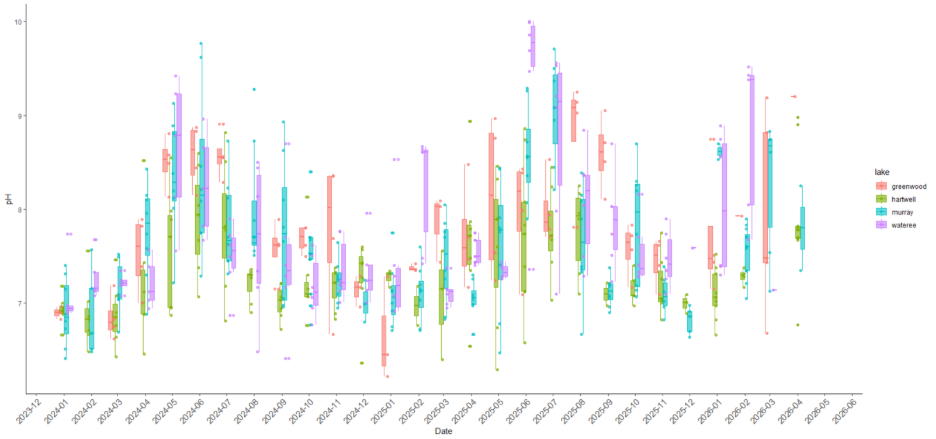
    Over the last few years, pH values exceeding 8.5 have been common in Lake Greenwood generally between the months of May and September. The SCDES Ambient Water Quality Monitoring Program recorded pH values >8.5 in March and April 2026. Available here is the detailed survey of the lower lake conducted by SCDES on May 8, which documents a surface water pH range of 7.7-8.1. This range of surface water pH values is more consistent with typical spring conditions.  
     
    The feature of relatively high pH values in March and April has also been documented in large lakes across the state and is likely related to the ongoing drought in the US Southeast region. For context, the chart below displays surface water pH values in Lake Greenwood, Lake Murray, Lake Wateree, and Lake Hartwell since 2024. Measurements of pH follow a typical seasonal pattern of lower values during the winter months and higher values during the summer months, with frequent observations of pH >8.5. While pH values in this range area re slightly elevated for the months of March and April, these values are within the expected annual range for lakes in South Carolina.  

  • Metals Testing in Surface Water 
    SCDES conducts routine quarterly monitoring of metals in surface water across the state. Results of Lake Greenwood metals testing since 2020 are available here. Metals commonly associated with toxicity including cadmium, chromium, lead, mercury, nickel, copper, and zinc are extremely low in Lake Greenwood, generally below analytical method detection limit.  
     
    There are no metals-based water quality impairments for Lake Greenwood. There are also no mercury-based fish consumption advisories for Lake Greenwood. 

  • Video Alleging Chemically Burned Leaves  
    An SCDES botanist reviewed online video of alleged chemical-singed leaves. The expert’s opinion is the leaves were dying because they were submerged in water for a prolonged period of time. The leaves were starting to decompose and were not chemically burned.   

  • Cluster of Dead Vultures Below Lake Greenwood   
    SCDNR reported that the avian flu was the likely cause of death of the group of vultures identified below Lake Greenwood. 

  • SCDES's Statewide Ambient Surface Water Quality Monitoring Program 
    SCDES conducts its Ambient Surface Water Monitoring Program using two complementary approaches: a long‑term Base Network and a rotating Statistical Survey Network. Click here to read an overview of SCDES’S Ambient Surface Water Quality Monitoring Program. 

  • NPDES Program Regulating Point Source Discharges to Surface Waters 
    All point source discharges to surface waters are required to have an NPDES permit (National Pollutant Discharge Elimination System). The NPDES permit program was established under the Clean Water Act to prevent water pollution by regulating discharges from point sources, such as pipes, ditches, or other discrete conveyances, into waters of the United States. Click here to read more about how the NPDES program regulates point source discharge to surface waters 

The investigation into the cause(s) of the fish kill that occurred between April 13-20 in areas of Lake Greenwood is ongoing. The S.C. Department of Environmental Services (SCDES) continues to perform sampling and assessments to try to identify the cause(s).

SCDES’s Aquatic Science staff assessed the lake again today (May 8) by boat and observed no dead fish or dead snails. Surface water pH throughout the lower reaches of the lake ranged from 7.7 to 8.1, a considerable decrease from the elevated levels observed in April. 

At this time, the cause(s) of the fish kill has not been determined. 

Early in the investigation a general precaution was made to avoid contact with the water in areas where the fish kill had occurred, however, current water quality data do not indicate a concern for consuming fish or for recreating in the lake.

New key updates include:   

  • Fish sampling 
    SCDES collected live fish from Lake Greenwood on May 5-6. Filet and whole tissue largemouth bass, bluegill, flathead catfish, redear sunfish, and channel catfish samples will be analyzed for a comprehensive suite of metals, organochlorine pesticides, organophosphate pesticides, and polycyclic aromatic hydrocarbons (PAHs). An additional post-mortem sample will be analyzed for these parameters as well as polychlorinated biphenyl (PCBs), dioxins, and furans. Results are pending. 

  • Water quality 
    SCDES maintains four routine monitoring locations in Lake Greenwood; water quality monitoring data for Lake Greenwood is available here. Neither the routine monitoring data from these stationary monitoring sites nor the special water sampling conducted as part of the fish kill investigation indicate any elevated or concerning water quality readings. 

    • As provided previously, Lake Greenwood has two drinking water intakes for providing public drinking water (Greenwood Commissioners of Public Works and Laurens County Water and Sewer Authority), neither of which are located in areas where the fish kill has been observed. Both utilities have confirmed their drinking water is in compliance with all drinking water standards.    

  • Sediment sampling from nearby properties 
    A nearby property to where the fish kill was observed is known as the Ascend Site. The property owner entered into a Voluntary Cleanup Contract with the agency in 2016. A Voluntary Cleanup Contract (VCC) is an agreement between a company and SCDES in which the company agrees to assess and remediate a site that is known to be contaminated due to previous industrial operations on the property. A VCC requires the owner to conduct an investigation and perform environmental cleanup with SCDES oversight. The VCC determines the necessary actions for safely cleaning up the site. As part of the VCC for this site, the property is routinely monitored and has multiple protocols in place for preventing offsite impacts – this is standard for VCC sites throughout the state.

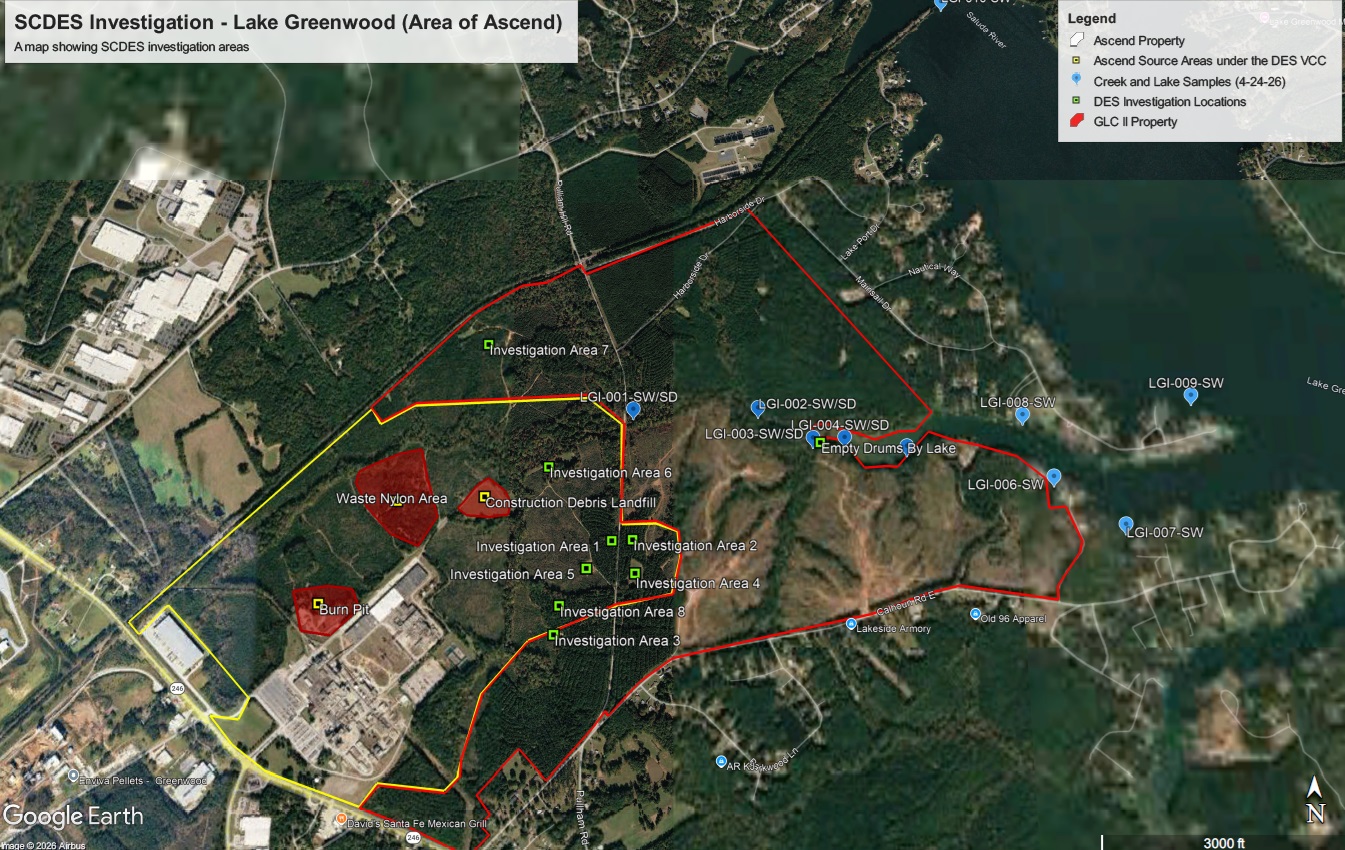
    • Neither the ongoing environmental monitoring occurring at this site as part of the VCC nor the investigative sampling recently conducted indicate any impact from the Ascend Site on Lake Greenwood. The investigative sampling results are available in this report.

    A parcel of land is located between the Ascend Site and Lake Greenwood, as indicated in the red-outlined area in this map (image below). A Phase I assessment report was conducted for this parcel and was submitted to SCDES in April 2026. This report indicates that the property did not have any environmental issues of concern.    


  • Site Activities Performed by SCDES
    Summaries of SCDES's site activities to investigate the cause(s) of the April fish kill are below:

  • Permitted wastewater dischargers 
    There are seven permitted wastewater dischargers within 20 miles directly up-gradient of the areas of the fish kill, as identified in this map. SCDES has been in contact with each facility and requested recent discharge monitoring data. Each facility reported effluent parameters within allowable limits, and no discharger stated to have had any process anomalies.

    On May 7, SCDES was made aware of a sanitary sewer overflow from one of these seven permitted wastewater dischargers — Ware Shoals Water and Sewer District — located approximately 20 miles up-gradient of the area where the fish kill occurred. The utility worked to quickly stop the SSO and issued a public notice. Based on the size of the SSO and the distance of the SSO from the area of the fish kill — approximately 20 miles — it’s highly unlikely this would have been a contributing factor to the April fish kill.   

As was previously provided, some of the most frequent causes of fish kills are oxygen depletion, excessive algal blooms and high water temperatures. None of these common causes appear to have been a contributing factor to this fish kill. 

Additional information can be provided to SCDES using our online ReportIt! tool (des.sc.gov/ReportIt) or contacting the agency at (803) 898-3432. 
State and local authorities continue to work together to investigate the recent fish kill in areas of Lake Greenwood in Greenwood County. The S.C. Department of Environmental Services (SCDES) and S.C. Department of Natural Resources (SCDNR) continue to perform assessments of Lake Greenwood; both agencies had staff assessing the lake by land and boat multiple days this week.  

At this time, the cause(s) of the fish kill has not been determined. Key updates include: 

  • SCDES reports no unusual water quality data based on commonly measured water quality parameters.  
  • The two drinking water intakes for providing public drinking water (Greenwood Commissioners of Public Works and Laurens County Water and Sewer Authority) are not located in areas where the fish kill has been observed, and both utilities have confirmed their drinking water is in compliance with all drinking water standards.   
  • SCDNR reports no indication of diseases or concerns among the fish sampled.
  • There have been no new reports of dead fish since April 20.  
  • Two properties near the lake are under investigation:
    • The first property is the former Monsanto/Ascend site where ongoing environmental cleanup and monitoring are occurring. No connection has been found between this property and the fish kill at this time.
    • Three empty drums were identified approximately 20 feet from the lake at a second property nearby on April 30. SCDES investigated the area near the empty drums on May 1 using advanced technology to determine whether any other drums were buried at the site. No buried drums were identified at this site. SCDES also screened the empty drums and the soil around the drums for organic vapors, and none were detected.
    • There is an ongoing investigation of additional sites based on reports from the public.      
  • Current water quality data does not indicate a concern for consuming fish. 

As was previously provided, some of the most frequent causes of fish kills are oxygen depletion, excessive algal blooms and high water temperatures. None of these common causes appear to have been a contributing factor to this fish kill. The property owner — GLH II, LLC — is fully cooperative.    

SCDES and SCDNR continue to investigate and will provide additional updates as new information becomes available. State officials encourage the public to follow trusted news sources for the most recent information. 

To report information related to this fish kill or any fish kill, contact SCDNR’s 24-hour reporting line at 1‑800‑922‑5431

SCDES, SCDNR and Greenwood County officials continue to work together to investigate the recent fish kill in an area of Lake Greenwood in Greenwood County.

Both state agencies continue to receive and review sample results as well as follow up on information provided by local residents in order to try to determine the cause.

Lake Greenwood has two drinking water intakes that supply public water systems: Greenwood Commissioners of Public Works and Laurens County Water and Sewer Authority. Neither of these drinking water intakes are located in areas where the fish kill has been observed. SCDES has been in contact with both facilities, and both report their finished water that is provided to customers is in compliance with all drinking water standards.

As was previously mentioned, some of the most frequent causes of fish kills are oxygen depletion, excessive algal blooms and high water temperatures. None of these common causes appear to have been a contributing factor to this fish kill.

State officials recommend people and pets refrain from contact with water in locations the fish kill has been observed, as referenced in this map.

This image is a labeled map of Lake Greenwood, showing various points of interest like Black Goat, Irvinies Landing, Lake Greenwood State Park, and Summersett Bay Rd. The map is provided by the South Carolina Department of Environmental Services.

Greenwood County Lake Management, SCDES and SCDNR will continue to investigate and provide additional updates as new information becomes available.

To report information related to this fish kill or any fish kill, contact SCDNR’s 24-hour reporting line at 1‑800‑922‑5431.


State and local authorities are working together to investigate a recent fish kill in an area of Lake Greenwood in Greenwood County. Greenwood County officials, the S.C. Department of Environmental Services (SCDES) and S.C. Department of Natural Resources (SCDNR) were notified of several dead fish in the Cross Hill area of Lake Greenwood on April 13 after receiving reports from the public. The agencies have been investigating, and at this time, the cause(s) of the fish kill has not been determined. 

Greenwood County’s Lake Inspector and Lake Manager responded promptly to assess the situation and reported their findings to SCDNR, the state agency responsible for managing fish populations on the lake, and SCDES, the state agency responsible for monitoring ambient water quality.

SCDNR has collected fish samples for analysis, and SCDES has conducted assessments and collected water samples in the affected area. Additionally, as part of ongoing investigations, SCDES is contacting facilities located upstream of the fish kill to determine whether any operational issues have occurred and to request their latest monitoring results.  

SCDNR reports the fish kill has impacted mixed species, including crappie, yellow perch, flathead catfish, striped bass and bluegill. The majority of reports related to the fish kill have been localized to the lower portion of the lake, below the lower train trestle. Isolated reports of single dead fish in other areas of the lake are likely not related to this incident.

Fish kills, which are instances when large numbers of fish die suddenly within a body of water, are relatively common and can be caused by various environmental, biological and human-related factors. Some of the most frequent causes of fish kills are oxygen depletion, excessive algal blooms and high water temperatures. None of these common causes have been observed at this time with this particular fish kill.  

Greenwood County Lake Management, SCDES and SCDNR will continue to investigate and provide additional updates as new information becomes available.

To report information related to this fish kill or any fish kill, contact SCDNR’s 24-hour reporting line at 1‑800‑922‑5431.

On April 17, 2026, SCDES staff collected water column data (i.e., vertical profiles) at nine locations across Lake Greenwood as part of the investigation into the cause of a fish kill. Sensor-based measurements were collected from the surface to the bottom of the lake and included pH, dissolved oxygen (DO), water temperature, specific conductivity and turbidity.

Data collected during this effort did not show evidence of water column-based features such as low DO or abnormally warm temperatures commonly associated with fish kills. The lake vertical profiles appeared typical for this time of year with normal temperature and oxygen levels throughout the water columns. The April 17 water column results are available here.