

Permit Requirements
The requirement to obtain a permit applies to construction of new dams that meet the size to be regulated, as well as to alterations, repairs, and removals of existing dams that are regulated.
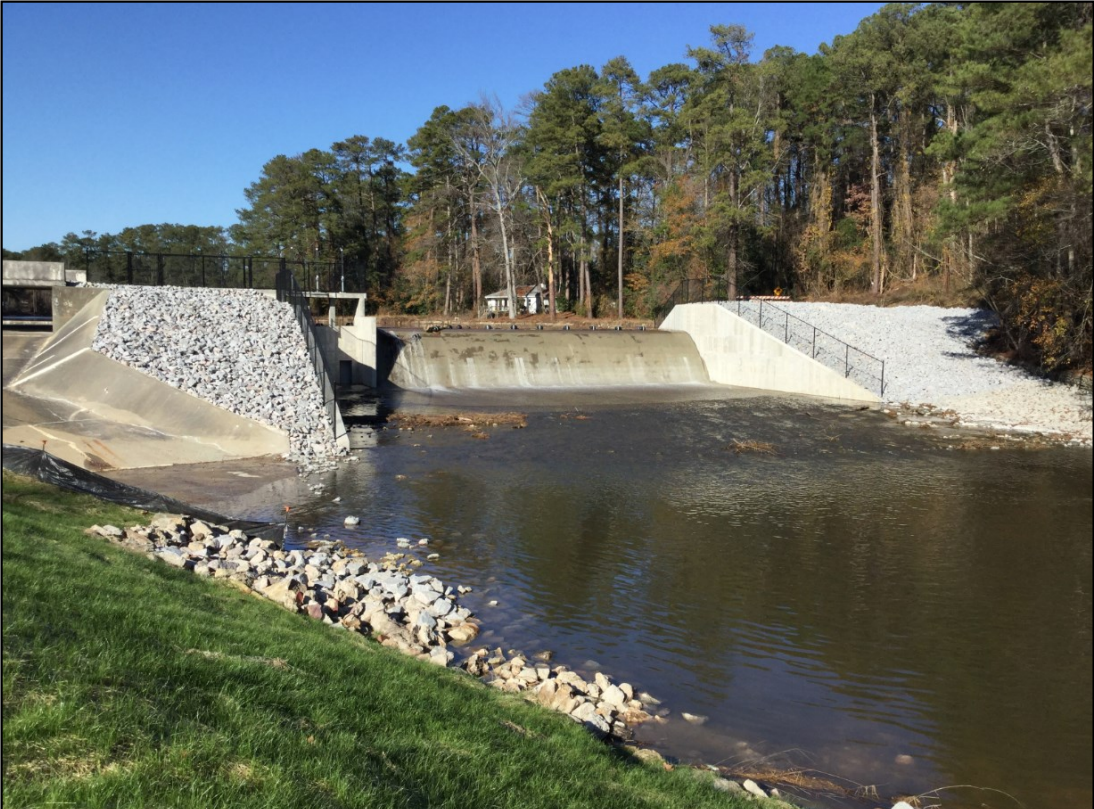
A dam can be regulated by the state if it:
- Is 25 feet or greater in height from top to bottom of the structure
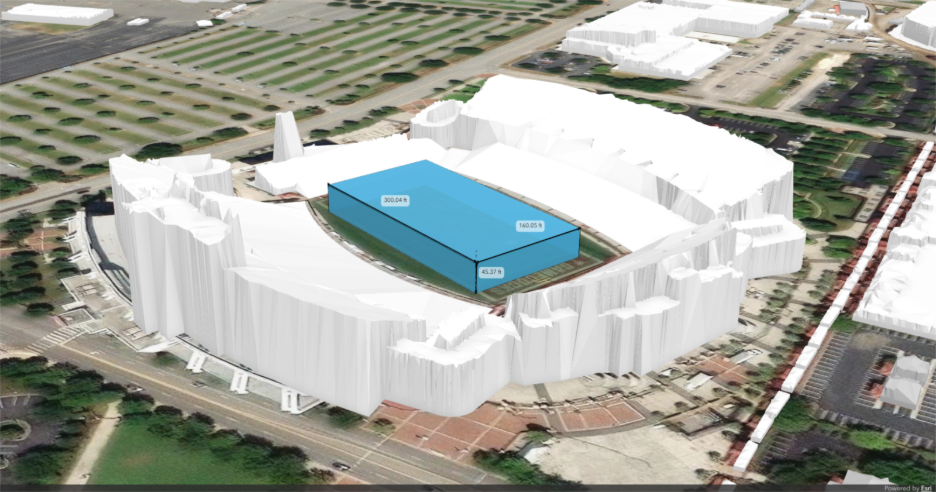
- Can impound (hold back) 50 acre-feet (2,178,000 cubic feet) or more of water at maximum storage elevation (i.e., the top of the dam)
- Represents a high-hazard potential where improper operation or dam failure may cause loss of human life, regardless of the overall size of the dam
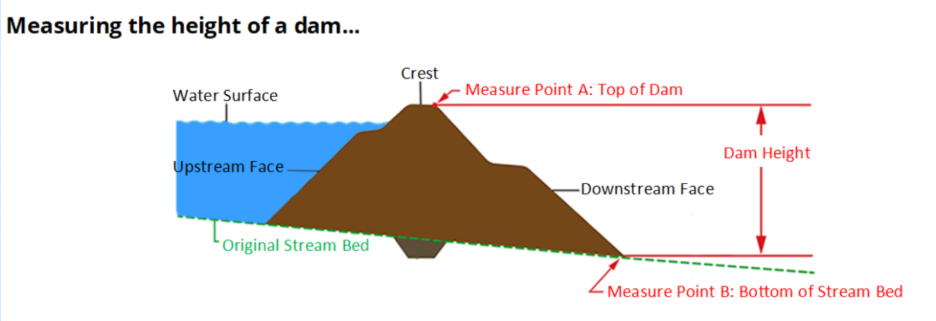
The above graphic displays the proper way to measure the height of a dam and the below graphic displays 50 acre-feet in comparison to Williams Brice Stadium.
Dams exempted from state regulation are those that meet at least one of the following criteria:
- They do not meet the size and potential hazard criteria for regulation
- They are owned or operated by a department or agency of the federal government
- They are owned or licensed by an appropriate federal licensing agency in the department's judgment, including the Federal Energy Regulatory Commission or the United States Army Corp of Engineers
- Where the South Carolina Department of Transportation or a county or municipal government has accepted maintenance responsibility for a road or highway and that road or highway is the only danger to life or property if the dam were to fail
- In the Department's judgment and because of the dam's size and location, there is no significant threat or danger to downstream life or property.
The South Carolina Dam Safety Program is governed by the Dams and Reservoirs Safety Act (SC Code of Laws, Title 49, Chapter 11, Article 3) and the Dams and Reservoirs Safety Act Regulations (SC Code of Regulations 72-1 through72-9). The complete text may be found here. Regulation 72-3 outlines which activities require a permit:
1. Construction of a new dam: (72-3, Section B-1) “Construction of a new dam shall not commence until the owner has applied for and received a permit to construct from the Department, except for any new dam exempt from the statute.”
Dams exempt from regulation have a maximum impoundment volume less than fifty acre-feet and are below twenty-five feet in height and will not endanger human life in the event of a failure. Others may be exempt if they pose no significant threat to downstream life or property. For example: A dam is immediately upstream of the ocean or other major water body and there are no structures or utilities between the dam and the receiving water body, then that dam may be exempt.
2. Repairs or Alterations to an existing dam: (72-3, Section B-2) and (72-3, Section B-3) “Repairs proposed voluntarily or pursuant to an inspection and repair order require permitting. Should the owner be uncertain as to whether the proposed work is repair or normal maintenance work, he should contact the Department for clarification. In case of an emergency where the owner finds repairs are necessary to safeguard life or property, the owner may start such repairs immediately but shall notify the Department at once of the proposed repair and work under way.” “Alteration of a dam or reservoir includes but is not limited to changing the height of a dam, increasing the normal pool or principal spillway elevation, or changing the elevation or physical dimensions of an emergency spillway.”
Permits are required for most repairs but are generally not required for maintenance. What is the difference? In general, “repairs” relate to work that impact the design operation or structural integrity of the dam and “maintenance” relates to work that could be considered “good housekeeping” and does not affect the design operation or structural integrity of the dam. “Maintenance” can also be thought of as work that, if neglected or postponed, could result in degradation of the dam to a point where “repairs” become necessary. As an example, a repair (requiring a permit) is removing trees that are greater than four inches in diameter at breast height, because at this size it is expected that the tree’s root system will have extended deep into the dam creating a possible structural integrity concern. Trees less than four inches in diameter may be removed as maintenance. Similarly, filling eroded areas twelve inches deep or greater is considered a repair and requires a permit, where as filling eroded areas less than twelve inches deep is considered maintenance and does not require a permit.
3. Removal of an existing dam: (72-3, Section B-4) “Removal of an existing dam shall not commence until the owner has applied for and obtained a permit from the Department to accomplish the proposed removal.”
A permit is required to remove any non-exempt dam. Just because a dam is not currently impounding water (whether the lake has been drained, or the dam failed in a storm) does not mean that it has been removed. Removal of the dam, which can be a technically complicated issue, generally means permanently removing a section of the dam large enough that the dam loses its ability to impound a potentially dangerous volume of water. An engineering analysis is generally required to demonstrate whether this is true. Once the Department is satisfied that a dam has been removed, then the dam ceases to exist in the eyes of the Department, and the landowner is no longer subject to SCDES’s Dam Safety regulations. Remember, all permit applications AND work performed under a permit requires the involvement of a Professional Engineer licensed in the State of South Carolina. A great deal of time and expense can be avoided by taking care of your dam and performing preventative maintenance to address those small problems before they become big problems requiring repair! If you are not sure whether a proposed dam would be considered exempt, or you have questions about repairs, maintenance, or removal, please contact your Regional Dam Safety Engineer for assistance.
With passage of the State’s FY2026 Appropriations Act a new requirement on SCDES permitting took effect July 1, 2025. This law contains the following language which affects SCDES permitting:
“55.26. (DES: Permitting Timeframes) Except for Energy Infrastructure Projects, which are defined as the construction, placement, authorization, or removal of energy infrastructure including, but not limited to, electric transmission and generation assets, natural gas transmission assets, and all associated or appurtenant infrastructure and activities, including communications and distribution infrastructure, the Department of Environmental Services will issue a decision on a completed application for a permit no later than ninety days after the date the application is received by the department. The department may require a preapplication meeting with the applicant to establish milestones within the review period prior to commencing the ninety-day review period. The department and applicant may mutually agree in writing to extend the ninety-day review period. Such agreement shall be in writing and state a specific date on when the extension will end. The department shall not stop, stay, or otherwise alter the review period without such written agreement with the applicant.”
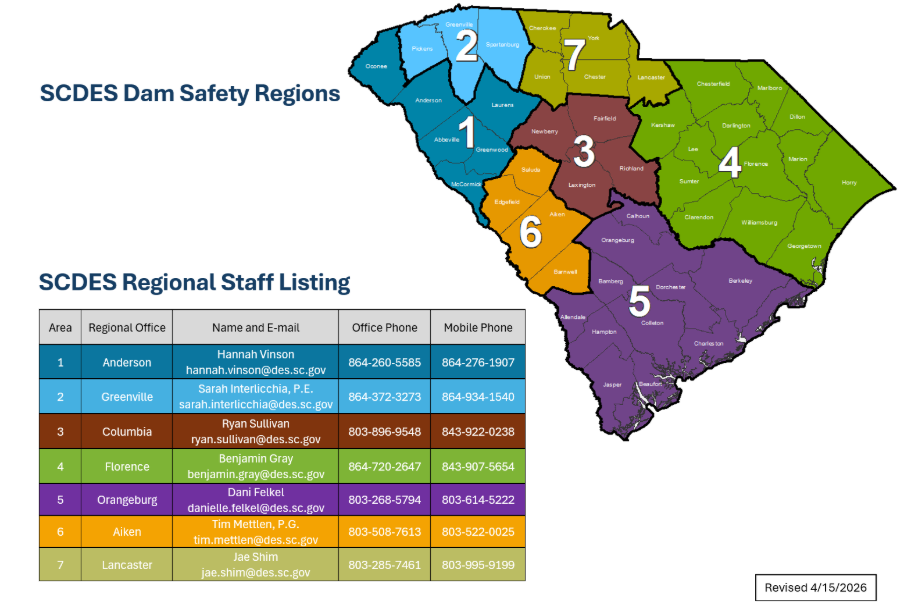
This will be implemented by the Dam Safety Program in several ways:
- New application forms: In addition to a long-needed revamp of our permit application form (Form D-2602) to capture more vital information about the dam and the proposed project, we have created a new, Notice of Intent to File a Permit Application form (Form D-25-0028), which allows dam owners to notify us early in the process that a project has been envisioned and exists in concept but finer details remain to be determined. This allows Dam Safety Program staff to provide the dam owner with a better idea what regulatory requirements will be applicable, establish a timeline for permit application review and permit issuance, advise on whether other permits or reviews (e.g., US Army Corps of Engineers) may be needed, etc. All SCDES forms can be found at the following website: https://des.sc.gov/permits-regulations/permit-central/all-forms-applications
Click on “Bureau of Water” in the header or scroll down to the section titled “Bureau of Water” and look for the sub-section titled “Dams” to find the new permit application forms and other Dam Safety Program forms.
- Preapplication meetings. As authorized by the FY2026 Appropriations Act, the Dam Safety Program is requiring preapplication meetings for all permit application submittals. These meetings can be performed via virtual meeting or telephone conference, if desired, rather than an in-person meeting. A permit application will not be considered “complete” until the holding of a preapplication meeting with the licensed professional engineer (PE) developing the permit application and, at his or her option, the dam owner/applicant. The preapplication meeting is intended to serve the purpose of establishing early in the permitting process what elements of a permit application are required based on the dam’s size, hazard potential classification, and type of work proposed, whether for new construction, repair, alteration or removal of a dam.
90-Day Permitting Timeline. To comply with the 90-day permit decision timeline contained in the FY2026 Appropriations Act, Dam Safety Program staff strive to respond to complete permit applications with either a permit decision or review comments within 30 days of receipt. As stated above, a permit application isn’t considered “complete” until a preapplication meeting is held AND the application is reviewed and found to contain all elements required by regulation. Additionally, please note that the Act does not require the Department to issue the permit within 90-days; it requires the Department to render its decision to either issue or deny the permit in the specified timeline. The Act also allows the Department and applicant to agree to a longer permitting timeline if needed, but the alternate timeline must be agreed to mutually in writing.
The full permitting process followed by SCDES can be found on the Permit Flow Chart.
Section 12-6-3370 of the 1976 South Carolina Code of Laws provides for a state tax credit for the construction, installation or restoration of water impoundments and water control structures used for certain purposes. That Section of the 1976 Code is printed here:
Section 12-6-3370. Tax credits for construction, installation or restoration of water impoundments and water control structures.
- A taxpayer may claim a credit for twenty-five percent of all expenditures for the construction, installation, or restoration of ponds, lakes, other water impoundments, and water control structures designed for the purposes of water storage for irrigation, water supply, sediment control, erosion control or aquaculture and wildlife management, providing these items are not located in or adjacent to and filled primarily by coastal waters of the State.
- In the case of pass-through entities, the credit is determined at the entity level and is limited to two thousand five hundred dollars. The maximum amount of credit for all taxpayers, including any credit passed through to the taxpayer from a partnership, "S" Corporation, estate, or trust, is also limited to two thousand five hundred dollars.
- If the credit exceeds the taxpayer's tax liability for the taxable year, the excess amount may be carried forward for credit against income taxes in the next five succeeding taxable years.
- To qualify for the credit the taxpayer must obtain a construction permit issued by the Department of Health and Environmental Control or proof of exemption from permit requirements issued by the department, the Natural Resources Conservation Service, or a local Soil and Water Conservation District.
To obtain the proof of exemption form referenced in (4) above, the owner must first insure that the dam is less than 25 feet high and will impound less than 50 acre feet of water and does not present a hazard for loss of life in case of failure (for dams of lesser size). Once the owner has determined with certainty that his dam does not meet the size requirements to require a permit, proceed with construction. When construction is complete, call the SCDES Environmental Quality Control Regional Office of the county in which the dam is located, and ask for the Dam Certificate of Exemption Form. The Regional Office will arrange for someone to meet the owner or his representative at the dam to verify its location, size, and use. That Regional Office representative will issue the Certificate to the owner, and the owner can then use that document to apply for the tax credit when he files his state income tax return on or before the following April 15th. For permitted dams, the permit to construct and certificate of completion should be filed with the state income tax return.
