SCDES to Begin Seasonal Water Quality Monitoring at S.C. Beaches
FOR IMMEDIATE RELEASE: April 16, 2026
COLUMBIA, S.C. — To help keep South Carolina beaches a favorite destination during the summer months, the S.C. Department of Environmental Services (SCDES) is beginning its seasonal monitoring of water quality along the coast. Every state with ocean-facing beaches performs beach water monitoring to help detect instances of elevated bacteria levels that have the potential to impact people’s health.
From May 1-Oct. 1, SCDES collects either weekly or bi-weekly water samples at 122 locations along South Carolina’s beaches, from Cherry Grove Beach near the South Carolina-North Carolina border to the southern end of Hilton Head Island. SCDES staff test these water samples for Enterococci bacteria. If elevated levels of the bacteria are detected, the agency issues public notices at that beach location and on SCDES’s Beach Monitoring webpage and the S.C. Beach Access Guide web app because high levels of Enterococci bacteria could negatively impact some people’s health.
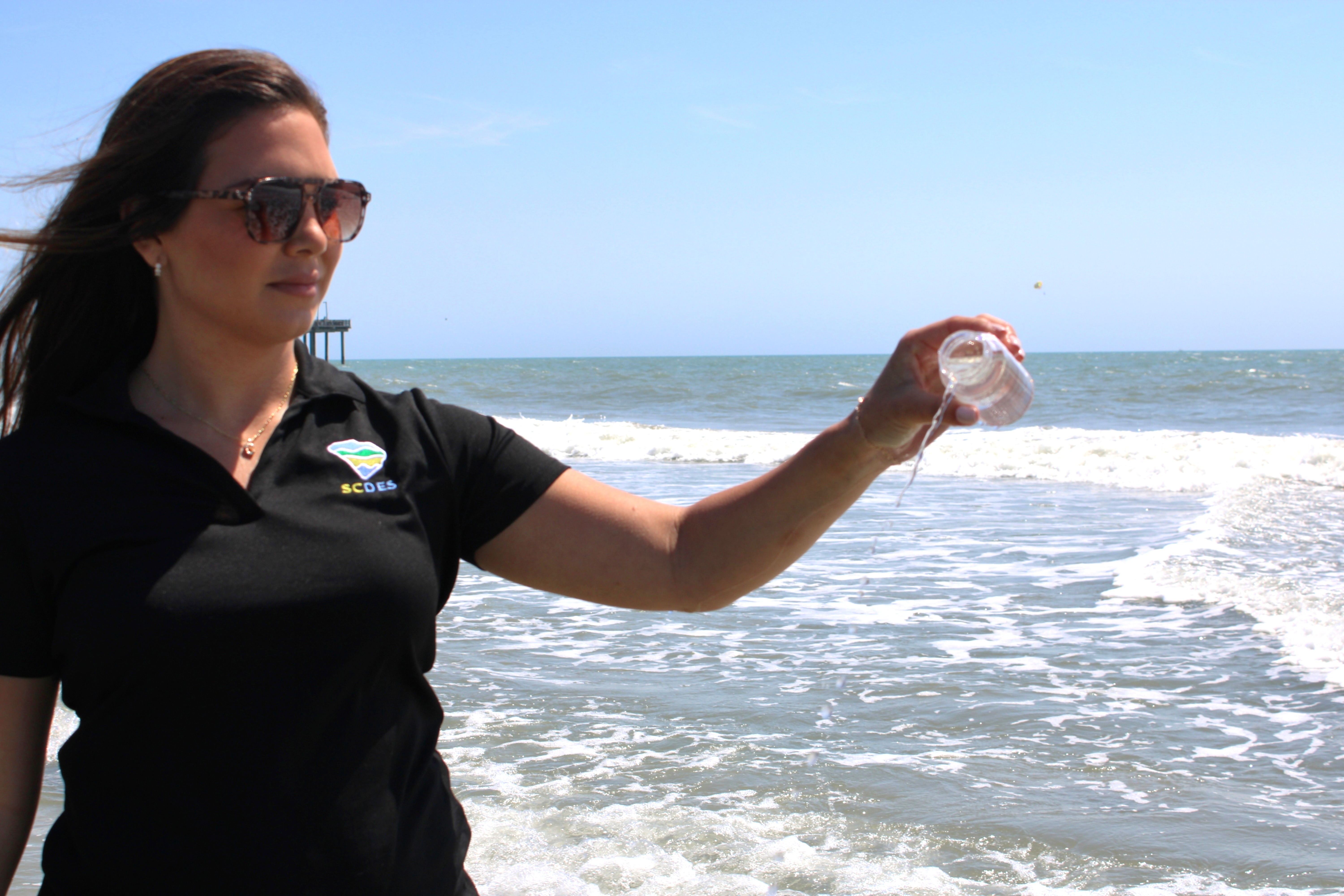
Jenae Padavano, with SCDES's Myrtle Beach Regional Office, collects a water sample at a monitoring site. SCDES collects ocean water samples at 122 locations along the coast from May to October to monitor ocean water quality during the busy summer months.
“If levels of Enterococci bacteria exceed the state standard, we quickly issue a short-term swimming advisory for that area of the beach to help notify beachgoers,” said Umi Hermann, Beach Monitoring Program Coordinator for SCDES’s Aquatic Science Division. “A swimming advisory does not mean the beach is closed — it simply means that portion of ocean water should be avoided until bacteria levels return to normal. Most short-term swimming advisories are lifted within a day.”
SCDES tests ocean water for Enterococci bacteria, which are naturally found in warm-blooded animals, including humans. However, high levels of Enterococci in water indicate the potential risk for other organisms that may cause disease in humans, such as gastrointestinal illness or skin infections.
The current advisory status for all 122 sampling sites is available on the online S.C. Beach Access Guide. SCDES issues two types of swimming advisories, short-term (or “temporary”) and long-term:
Short-term swimming advisories typically last one to two days and are issued when two consecutive water samples exceed the state water quality standard of 104 colony-forming units per 100 milliliters (104 CFU/100mL). Often, short-term swim advisories due to elevated bacteria levels are issued after heavy rains when rainwater washes pollutants into the ocean.
Long-term swimming advisories are issued year-round for areas that have an increased possibility of high bacteria levels, typically where stormwater from pipes or small creeks flows across the beach and into the ocean. Signs posted at these locations provide information about the potential of high bacteria levels. Locations with long-term advisories are reevaluated at the beginning of each year.
“While we may not always know the exact cause of elevated bacteria levels in a specific area, our role is to keep the public informed about current ocean water conditions so beachgoers can make educated decisions,” Hermann said. “It’s important to remember that ocean water is a natural environment and not chemically treated like a swimming pool, so there is always some level of risk associated with swimming in natural bodies of water.”
SCDES partners with the City of Myrtle Beach, the Myrtle Beach Area Chamber of Commerce, the Town of Edisto, and other organizations on the Check My Beach program, which is designed to provide quick access to water quality information as well as general beach safety tips. SCDES is working to expand the Check My Beach initiative to include other coastal communities. Visit des.sc.gov/beachmonitoring to learn more.